Where is the red door of Notre Dame?

This is also a Substack post. In late 2024, around the time Notre Dame in Paris was preparing to open to the public again, I was “virtually” walking around the magnificent building with the aid of maps and old photographs. Of course, the position of all the doors and beautiful rose windows have not changed in over one hundred years but still I couldn’t find the exact position of the red door.

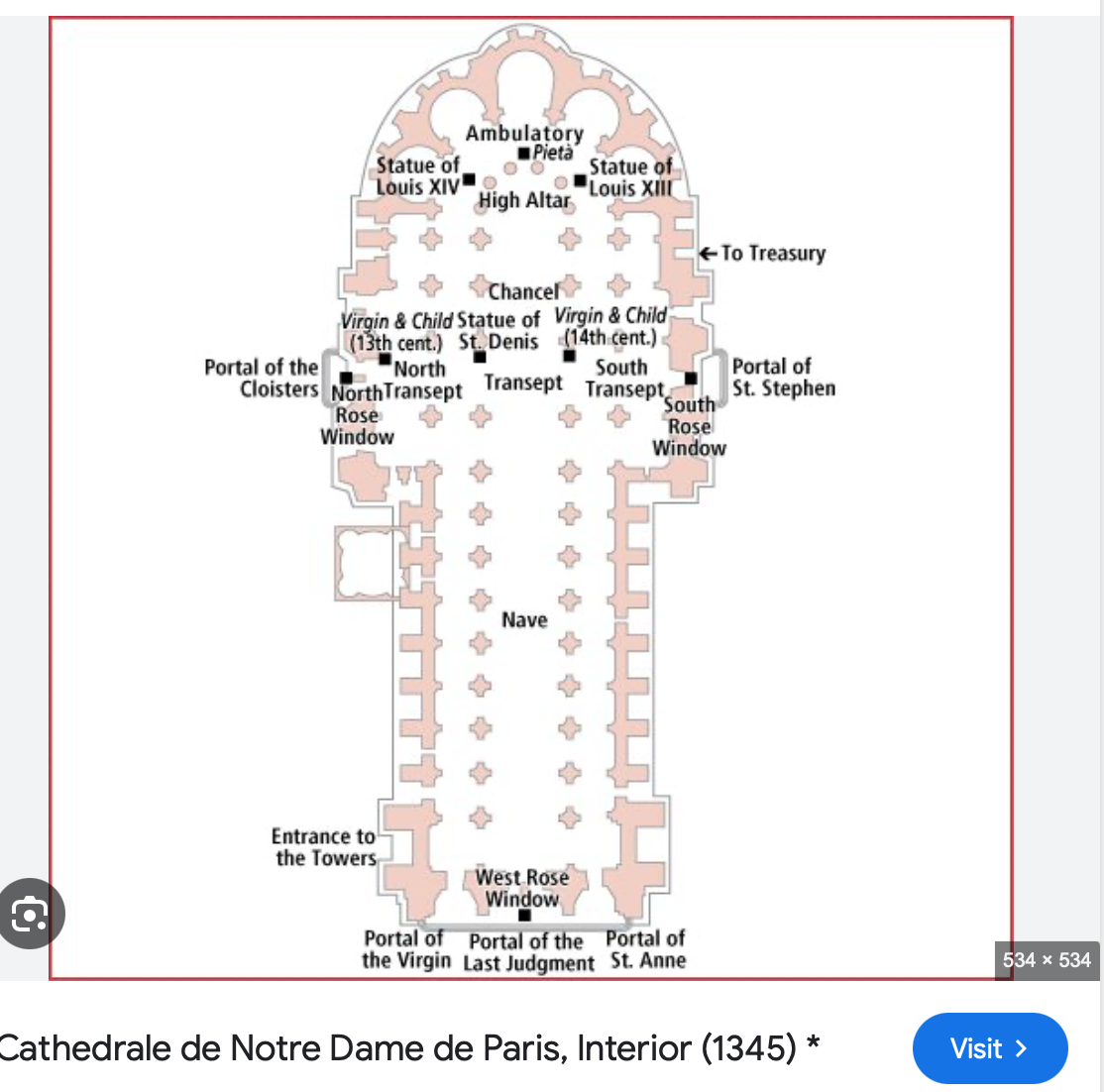
Finding the door, I believed at first, would just be a matter of studying a few layouts of Notre Dame and there it would be. This didn’t prove the case. In the picture above you will find one of many such layouts of the cathedral that don’t list the rouge portal.

Over several weeks I searched articles on the cathedral and even recent photographs. No red door. I began to write the scene anyway. My main character Sarah Montague is with her friend Lilith. Together they are going to visit a number of places in Paris that Sarah’s grandmother sketched back in the 1870s. They begin with Notre Dame and start their walk around the magnificent cathedral below the soaring buttresses.

They walk along the quai past the Portal of St Stephen and the South Rose Window. And then around to the magnificent Western Façade with the three portals: the portal of The Last Judgement in the centre, the portal of the Virgin on the left and the portal of Saint Anne on the right. By this time, they are half way around the building with no sign of the red door. They pass the Portal of the Cloisters and the North Rose Window and just beyond, nearly finishing their circumnavigation is the red door. 

I was able to confirm the position with a bright orange and yellow floor plan I found only four days before Notre Dame opened to the public. There it was – the portal rouge. Just before the curve of the Choir section of Notre Dame. A recent photograph confirmed the position. 

I went back through all my saved images to write this essay and discovered I had missed the red door early on in my research because it was marked as portal rouge. And I initially (and stupidly) wasn’t looking out for that name. I’ve also noticed that I missed a reference to it being on the north side. I have to admit that map reading is not my strong suit. 

I definitely know where this magnificent door built around 1270 is now, with its deep red colour and the four figures and an angel above the lintel. But I feel that having so much trouble finding the door made me really get to know the cathedral in depth. And I am thankful for that. 

Trouble with palm trees

Image courtesy of the State Library of New South Wales

So, I have spent a ridiculous amount of time today trying to find out when the palm trees in Bridge Street were removed. I’ve been through blogs, endless google searches, at least an hour at the City of Sydney Archives, eBay, Alamy you name it. It sounds trivial but I need to know the date so that I can place a flash I have written, chronologically, in my collection. For the moment their loss features in my just written flash but now I’m obsessed with the when.

I had heart failure earlier in the day when I found a postcard featuring the palms dated 1958, a date that completely rules out the flash from being included in my collection. But I’ve since found the photo below dated by the Sydney Archives as 1954 with no palm trees. So hopefully the trees were removed sometime in the early 1950s. It’s strange but there are not very many photos of the street in the 1940s. Because of the war perhaps?

You will see that the distinctive Burns Philp building features in both photos. I have also “asked a librarian” at the State Library the question so I will keep you posted on the outcome. In the meantime I’ll probably still be searching in my sleep.

Image courtesy of the City of Sydney Archives

Update: I heard from Kate, a librarian at the State Library, on the 22nd December and she confirmed through various newspaper articles that she found in Trove that the palm trees were chopped down in August, 1946. I’m not sure what I did wrong when searching Trove but I had no luck even though I tried “Any of these words” and “All of these words” for palm trees Bridge Street. Here is a small newspaper article:

Image courtesy of Daily Telegraph 26/8/46

And time marches on and over the intervening years so many more trees have been cut down in the name of progress.

How to get distracted writing historical fiction and/or the girl on the beach

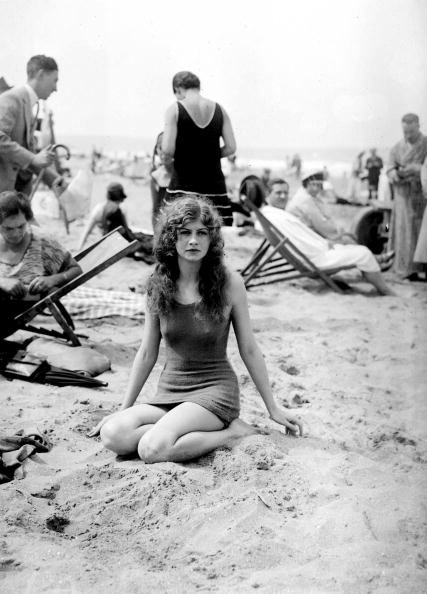
Source: ( Photo by Branger/Roger Viollet/Getty Images )

Girl on the beach 1925

Yes, it’s a serious problem for historical fiction writers when doing research – staying on track. In the 1980s I went through all the photography books (and there was a lot) at Dee Why Library. Of course I didn’t need to look at all the photos – most didn’t have anything to do with the manuscript I was writing but what the heck! Now with the net the problem is magnified 100 times over. The number of photos that are available is staggering. Google images, Instagram, Flickr, Trove – all waiting quietly (Hey, don’t mind me!) to lead you away from words on a screen/page.

In this instance Pinterest was the culprit. I had been googling 1920s clothes and pinning them on my board Research for my next novel. Pinterest, being very helpful, kindly said “You might like this!” and there was a board on the 1920s that I decided to follow. Some boards are small of course and only take a few minutes to glance over but occasionally I would find myself drifting away from my writing. You know how it is! I love that dress of Audrey Hepburn’s! And really, Warren Beatty was pretty good looking when he was young. Wow, I want to go to that French village right now. This sort of thing happens frequently when I’m on the net but no harm here! This board was on topic – the 1920s. I scrolled down through the images and there she was! Simply a girl on a beach, looking sad yet sort of posed at the same time. I was done for! My writing and research lost for the rest of the evening.

I found myself really studying the photo. Gosh, it does look posed. A publicity shot for a now unknown actress? A photographer friend suggested it was actress Edna Purviance, Charlie Chaplin’s leading lady in many of his films. I googled images of her and decided no, it wasn’t her. I then did a Tin Eye reverse image search. The one that was pinned on Pinterest had no name or details. Maybe another image might have more information. Tin Eye came up with 24 results and it appears the original photograph is a Getty image taken by the French photographer Roger Viollet with a title of “Swimmer on the beach of Deauville (Calvados), about 1925”. A location but no name!

I searched her face again. She really was very pretty! Maybe it was a lucky snap that became a bit of a hit and the damsel was pinned up wherever males congregate. I’m guessing she might have been extremely popular with the French Foreign Legion when the state of her chest was noticed! She is actually striking a pose similar to Farrah Fawcett in that that red swimming costume back in the seventies!

None of this helped me identify her of course and why is she sitting by herself? Is she waiting for someone?I believe she wasn’t an actress because I’m sure if she was, she would have been identified by now. I mean, how many photos do we view a day? Even when we aren’t researching, people put up posts asking please identify. Photos are multiplied over and over in vastly different locations. Gradually the dots are joined but not for the moment for my girl at the beach.

Three hours later after originally viewing her picture, my manuscript is pushed to the back of my mind. I have lost valuable time and asked unanswerable questions, such as: Who was she? Was she a model? What did she do with her life? She’s about the same age as my character. I wish I could chart her life through known facts so that I can have a few signposts for my girl; be made aware of what it was like to be young and beautiful in the 1920s.

She has led me on a merry dance but then I stop and look at her once more. Actually she hasn’t. I’ve only just realised why she caught my attention in the first place. She has abundantly thick and wavy hair – auburn, I’m guessing, just like my main character Sarah Montague’s. I haven’t lost time. Here is a real life sister for an imaginary young woman that I need to return to.

Casting the characters in your novel

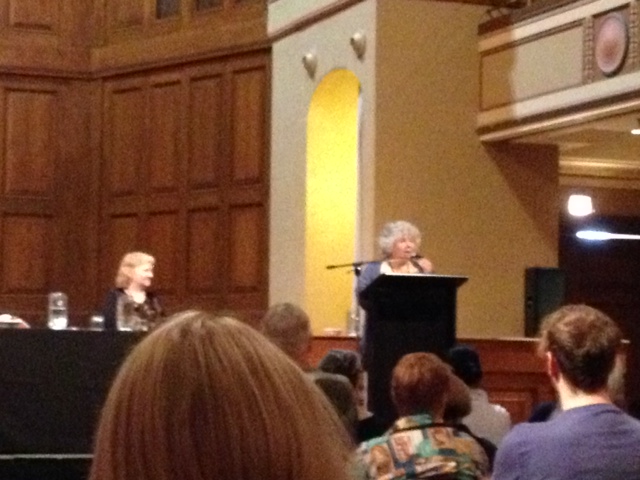
Miriam Margoyles at the Newcastle Writers Festival

Miriam Margoyles at the Newcastle Writers Festival

Do you, I’m wondering? I’d love to find out what other writers do. I’ve written six novels now. Three are as yet unpublished and I’m starting the rounds next month for my sixth. Strangely though, I’ve only ever cast one of my novels with “real” actors as opposed to descriptions in my head and on the page. Why is that?

I’m not sure except to say that the only one I have cast, is set in contemporary times – 2004 to be exact and I don’t think that is a co-incidence. In Crossing Paths there are eight main characters and they all have approximately 20,000 words each, which is a lot of “air” time. My main character Jane Townsend is the beautiful but fragile Rose Byrne. I just couldn’t imagine anyone else playing the role although she is in her thirties now whilst my Jane remains (in the inimical way of fictional characters) still in her twenties. John Cusack is Jeremy Braithwaite. No-one else will do and the same goes for the psychic medium and retired librarian Ruth Moon. She is none other than the indefatigable Miriam Margoyles who was part of Newcastle’s inaugural Writer’s Festival and did a brilliant and very entertaining Catherine de Bourgh for the discussion panel (see pic above) celebrating 200 wonderful years of Pride and Prejudice.

When you are picking actors to play your characters I think it is essential to aim high. Don’t bother with B grade, inexperienced actors. Grab the stars and that’s just what I did for my characters, particularly Mary Darling. Mary has just changed her surname and decided to run her family home on Vancouver Island as a B & B at the start of Crossing Paths. She is an excellent cook and the perfect person to run a B & B – she just doesn’t know it yet as she is lacking self confidence. Now I know Meryl Streep likes a challenge. Here’s one for her! Play a woman who is shy and seriously lacking in self confidence! Not sure I’ve ever seen her do that!

In Cornwall a gay, New Age writer is looking for love and I pretty much envisioned Rupert Penryn-Jones in the role of Jonathan Fairlight. His widowed mother and new bookcrosser Daphne is not one of the eight main characters but I’m sure Helen Mirren would have fun with the role, particularly with her new friend Miriam Margoyles aka Ruth. Have they ever acted together? I don’t think so.

Now the last three characters I didn’t actually cast but that was because suitable actors, I believe, are in abundance for those three roles. A pretty Greek actress who has rudimentary English for Eleni, a sophisticated French actor in his late fifties for Pascal, a French biographer. And lastly a good looking, enigmatic African American actor in his thirties for Russell, a Boston bookshop owner. Too easy!

As for my other novels – my first I don’t think it entered my head to chose actors. It was enough to actually be writing. My second unpublished novel was peopled mainly with my ancestors so it was kind of impossible to make casting decisions. As it was I used my family tree to create the extensive family histories of both the Kittos and the Wearnes and as a result I have messed up my knowledge of actual facts. I’m no longer an expert on our family on my father’s side! Fact and fiction has been irreparably combined in my mind.

For my third unpublished book I was dealing with two sisters from two different times . Both sets of sisters – one beautiful and one plain were inspired by a photo of two sisters from the thirties and with these real women in my head, there was no way my mind was going to make the leap to actors. And I think that’s as it should be.

Likewise my first published novel, Tomaree was also inspired by real people so apart from studying the physical appearance of a real US Serviceman and creating a character around some aspects of him and making my female character a redhead, no one came to mind!

For my last novel, the recently completed manuscript of The Grey Silk Purse no actors have put up their hands. I’m of the belief too that it is often a good thing (particularly when the past is concerned) to let the reader reconstruct the appearance of characters. I’ve had a lively discussion on the subject with Matthew Ward of Mary Celeste Press as to the pros and cons of putting a real person’s face on the cover of a book. If there is no face, the reader can choose a suitable actor if they want to. Or they can decide on a full description in their head (from a few details supplied by me). Either works but it is fun as a writer (when it does happen) to play along with a real life actor, give them exciting action and dialogue and watch a novel spring to life with their help!

Writing the final draft of your novel…or maybe the second last draft

Words taking flight!

Words taking flight!

Sometimes it’s hard to tell! I’m currently on the 4th draft of The Grey Silk Purse. I believe it is the second last draft but then I thought the 5th draft of Tomaree was the last way back in around 2004. The last was actually finished (the 8th) in 2008 so you see it’s a tricky business!

Ideally, of course, when a writer believes they are on the home stretch they should put the manuscript away for a few months and only then have another look before completing the final draft. I wish! I’d love to have the luxury of being able to do that but, frankly, I would go mad! Not writing is not a option for me!

An alternative the experts say is a change of scene. Wouldn’t a European trip be lovely? Paris, Rome, several mountains in Switzerland, a week in Venice. A mediterranean cruise I’m sure would clear a few cobwebs. One can dream!!

Crossing out those two options, what can be done to clear the air so that we can approach our manuscript with fresh eyes? My suggestion and what I am currently doing is:

Read someone who writes completely differently from ourselves; preferably someone whose style, sentence constructions, choice of subject matter is alien. 

Immediately for me two writers step forward. The first is Philip Roth. In my review of The Human Stain I talk about what it is like to read a Philip Roth. It is like being picked up by the scruff of the neck and dragged along. You can kick and scream against the intensity and speed that you are travelling but somehow you just can’t put the book down.

The other writer is John Banville. In his magnificent novel The Sea the reader is relentlessly tossed and scoured by his prose which sweeps the reader from the shore to the depths of the ocean, often dragged mercilessly under to surface gasping for breath.

Either of these writers will do nicely to give me a fresh eye! I chose John Banville and here is my review of Eclipse, the first book in his Alexander Cleave trilogy.

Eclipse by John Banville

I’m not sure if I’ll make it through the other two books before going back to The Grey Silk Purse but I will try!