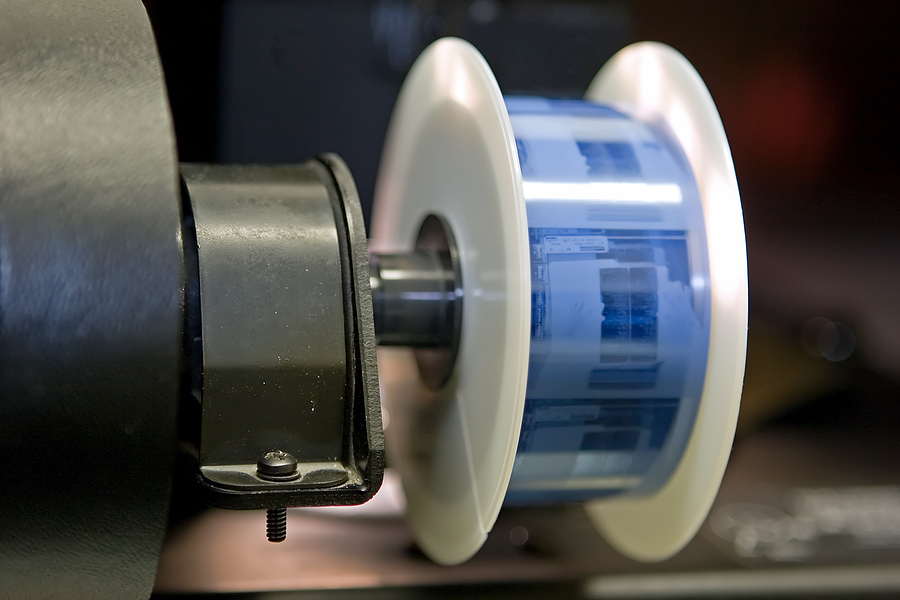
I hate Microfilm readers!

Firstly, I can never feed the film on and get it started. It takes me forever. I am not very co-ordinated and as I struggle with the stupid reel I feel like I’m back at school. Secondly I need the print quite large so I spend my time going up and down each page so I don’t miss anything. And guess what? After half an hour of winding and bobbing up and down I’m suffering from motion sickness. So, not surprisingly, I only lasted an hour reading the October and November issues of the Newcastle Sun, 1917 yesterday morning but found a lot to giggle over.

One of my favourite things is something called Men and Women Personal Paragraphs with snippets of information such as: “Mr and Mrs Penny returned to Newcastle from Inverell today.” Or try this one: “Mr and Mrs  P Gordon Campbell of Mayfield are spending a short holiday in Inverell.” Good to know!

And then there are strange ads for weird things like Fishers Phospherine, the Misses Tidey and Tinsley selling hats, Parisian Designed Frocks. Yes please. (Actually they didn’t look bad). There was a Mme Petrona in the movie The Panther Woman which sounds like it might give Sex and the City a run for its money and a news item entitled “Twice married woman thought husband dead.” I suppose she thought it was worth a try!

By this time I’m totally over the dreaded microfilm readers and haven’t found any ads for two cafes I know existed in Newcastle in 1922 – Tyrrells and Mitchisons. No more torturing myself on the reader. Instead next Saturday I’m going to do some research old style. I’m going to be flipping through newspaper clipping books, turning the pages leisurely and not listening to the crank of a microfilm reader.

Thank God for the snippers club at the Newcastle Family History Society at Lambton. They are a group of enterprising women who meet, chat and patiently snip out domestic and miscellaneous newspaper articles from the Newcastle Morning Herald and other local papers. Yes, I’m going there next Saturday morning and you might not hear from me again for weeks. After all I went there two years ago looking for the New Moon Dance Club who hosted the 1930 New Year’s Eve Dance Party at the Trades Hall in Newcastle and instead stumbled upon an article about a lost silver purse that inspired my current work in progress!

Lost in Time

People don’t change over the years but the environment they live in does. When Ishobel Ross, a cook from the Isle of Skye, arrives in London in July 1916 it is amazing how much she gets up to in the city without a car! She is sightseeing – taking in the theatre, a trip to Aldershot, shopping at Selfridges, visits to St Pauls, Marble Arch, and tea at Fullers. The list goes on and I’m exhausted reading it. Finally on the 29th she writes “Got word today (from the Scottish Women’s Hospitals) to report at Victoria Station on Tuesday morning.”

Got word? How? Obviously not by SMS or mobile call but I’m left pondering the alternative. Did the SWH ring Ishobel at her hotel? Send a telegram? From my research into the Twenties in Sydney it is amazing to someone from the 21st century how often they got mail in the early part of the last century: twice in the metropolitan area and for a time a delivery on Saturday which beggars belief. Telegrams too seem to arrive very quickly, including the dreaded ones from the War Office – “We regret to inform you…”

Did the SWH send a boy running through the streets of London with a message? Who knows? There is, of course no way of knowing now. As they say “you had to be there.”  And taking that line of thought I can imagine a 22nd century historian possibly stumbling over emails, letters, the odd diary, containing such lines as: “Met this great guy last night. Too good to be true so I googled him.”

Google may be around for another 100 years. Or it may be lost in time in the way of “got word” and “shanks pony” – a term my Mine Manager/diarist great-great grandfather Richard Pope frequently used in the 1880s. “Took ‘shanks pony’ into Silverton from Broken Hill.” A special breed of horse you are wondering? No, it means to walk. So there you are, you were way off course just as I maybe off course when I speculate on Ishobel’s “got word”.

The past is another country. They definitely do things differently there.

Virginia Woolf and I

We go back years! I first came to her writing because of A Room of One’s Own. I read it (like most women do) when embarking on my writing career. It was actually very sound advice and when I came to buy my first home as a single woman I was going to have that study if it killed me! I got the study at Eleebana and I now have one in my new home but not enough bookshelves I’m afraid. I now have boxes and boxes of books in the garage but I have somewhere to write besides my favourite cafe.

Last week I discovered that Virginia Woolf not only gives good advice but can be relied on in regards to the weather. A few weeks ago I started writing a new chapter entitled The News (all of my chapters have titles instead of numbers) and when describing the weather wrote: “It was cold but sunny.”  A very hopeful statement on my part I thought having lived through a London winter so I made a mental note to somehow check the actual weather for the 15 December 1917 later on. A few days after this I discovered there were actually two bombing raids in London that month which had me reeling in a orgy of research; as you do when an unexpected real life event turns up that puts a new twist on your writing.

After finding a marvellous book on the WWI blitz by Ian Castle http://books.google.com.au/books/about/London_1917_18.html?id=siHifpXFa6kC&redir_esc=y I looked up which library held the first volume of Virginia’s diaries (not for loan) and at Newcastle Library I sat and read her first words for the 15 December 1917: “A cold but sunny day.” Thank you Virginia!

And another thank you for an account of the first of the bombing raids on 6th December which helped me to bring my character’s account to life. According to Virginia’s diaries she was awakened by L to a most instant sense of guns. “As if one’s faculties jumped up fully dressed.” She goes on with a very vivid diary entry for the morning’s events.

As I said, Virginia and I go way back and I’ve now gone back further with her as I have begun to read her very first novel Melymbrosia written in 1912. http://www.goodreads.com/book/show/741136.Melymbrosia

London, December 1917

As a single woman in 2012 I often look around and wonder where all the single men of my age are. I should not complain! Imagine living in the UK, the US or Australia during the last year or two of World War I (or any major conflict for that matter) and every day seeing maimed and disfigured young men back from fighting; trying desperately to adjust to their new lives as invalids. If you were in your early twenties during those years it was highly probable that you would remain single – so many future husbands lying in cemeteries in Europe instead of alive and well and looking to the future.

In my manuscript The Grey Silk Purse Phyllis has just encountered, in a Sloane Square cafe, one such disfigured young man:

‘When I glanced towards the young man his face took my breath away. It was ravaged beyond belief. One eye appeared to be sewn shut and part of his face from his left forehead down was gone. In that instant I also noticed that his nose looked strange and his lips were shiny and bulbous.’

My character manages to stay calm. I don’t think I would have been able to. During the latter stages of WWI young men such as these were given new faces at The Tin Noses Shop as the Tommies called it – the real name being Masks for Facial Disfigurement Department at the 3rd London General Hospital. There was also some marvellous work being done at Sidcup by pioneer plastic surgeon Harold Gillies  http://en.wikipedia.org/wiki/Harold_Gillies and during WWII Archibald McIndoe, Gillies cousin http://en.wikipedia.org/wiki/Archibald_McIndoe who worked for the Royal Air Force and  operated on badly burned aircrew.

During WWII my English aunt who was a WREN was stationed near the hospital where McIndoe operated and was instructed to smile and not flinch when she encountered the aircrew wandering the grounds, recuperating after their operations.This memory of hers relayed to me is the inspiration of the scene I just completed today – art immitating life.

The World’s Worst Travel Agent

Yes, that’s me when it comes to moving my main character from A to B, ie England to Salonika during the last few days of 1917 to early 1918. Should I have her spend most of the travel time on board say, a French liner/hospital ship with the possibility of it being attacked by a submarine? During one week in April of 1917 55 ships were sunk in the Mediterranean. So maybe not…

Or then I can have her going overland to Le Havre, Rome, Taranto and then by ship via Corfu to Salonika but where did she stay on the way? On board the train or in small hotels? The mind wanders and at this rate she’ll never get there! She is stamping her foot in frustration and I’m dithering around like a maiden aunt. But then of course I know what is ahead of her: driving an ambulance along a torturous road with men crying out in pain in the back, freezing cold such she has never known in Australia, horrible sights that no-one should have to witness and young orderlies, VADs and nurses did witness, sometimes for years, more often than not working incredible hours that would compromise their health in later life. Yes, it’s all ahead of my Miss Summerville and I’m petrified for her. No wonder I am delaying sending her to Macedonia.

In fact I’m quite nervous about the writing of her Serbian diary. How did the real women live through it all? I am in awe of  women such as Sister Alice Kitchen who served through the whole of the war, Sister Ross-King who was awarded a Military medal for her bravery on the night of the 22nd July when her Casualty Clearing Station was bombed. And the wonderful dressing station sister Agnes Dorothy Kerr. Even just your average nurse who often worked up to 18 hours a day, particularly when  a convoy of wounded men arrived! They deserve to be remembered.
http://www.theage.com.au/news/opinion/lets-remember-the-bravery-of-thousands-of-australian-nurses/2007/04/23/1177180564828.html?page=fullpage

Now it’s back to getting my girl over there and into action. I know she is going to be fearless!

Writing Challenges and Passions

When I’m writing two very important things have to be there for everything to fall into place. 1. The writing of the manuscript has to challenge me in some way and 2. I  must be passionate about my subject matter. The Grey Silk Purse is my sixth book and both these things definitely apply. In my earlier novels this wasn’t quite so obvious to me. I was just writing a book! But now after writing prose for thirty years, themes and concerns do become clearer.

With my first novel, just putting my ideas down was enough of a challenge. I mean could I even finish the damn thing let alone write coherently? With my second novel this was even more true because I began writing the enormous (still unpublished second manuscript) when my second child was five months old. I have vivid memories of Elise in a capsule and me struggling to borrow a heap of library books before she screamed the place down. And later of clasping her as a toddler between my legs to stop her from crawling off whilst I desperately tried to finish some photocopying for my research into the Broken Hill Proprietary Co.

With my third manuscript the construction of the novel defeated me (for the moment) but themes were emerging. Themes of loss – loss of place, loss of memory. Of abuse and madness. With my first published book (and fourth manuscript) Tomaree the writing challenge was how to blend the past with the present; how to move smoothly from 1942 to 1972 and back again many times. Luckily the passion kicked in (a passion to raise awareness of the wonderful Australian GI brides who gave up everything for love).

For my last novel Crossing Paths, the challenge was enormous! To create eight very different characters and give them succint personalities. I’m not sure that I succeeded but I gave it a fair old try. And the passion was of course for the wonderful world of BookCrossing.

Now I am facing a new writing challenge and it is quite daunting – to recreate life as an  ambulance driver working in the Macedonian front of 1918; my passion to highlight the wonderful work of the Scottish Women’s Hospitals and other heroic women such as the Australian Olive Kelso King.
Wish me luck!!

On Memory

an island boatrower's hands

One of the things that drives me as a writer, my passion I suppose you could call it, is to recreate the past incorporating memories of those that were there or there through their parents’ recollections. It is very important to me to uncover these personal details that can make the past come alive – because not everything is recorded in history books.

Nine years ago I began interviewing many elderly residents of Port Stephens to help me understand what Nelson Bay was like during WWII for my novel Tomaree. This time I am writing about WWI so I am relying heavily on first hand accounts of people that of course have since died. Luckily, I have though, two helpers who are very much alive: Vera Deacon and Helen Marshall. Both have memories going back to the Thirties and Forties and as Mayfield didn’t change too much from 1920 until about 1935 or so, I am able to use a lot of those memories.

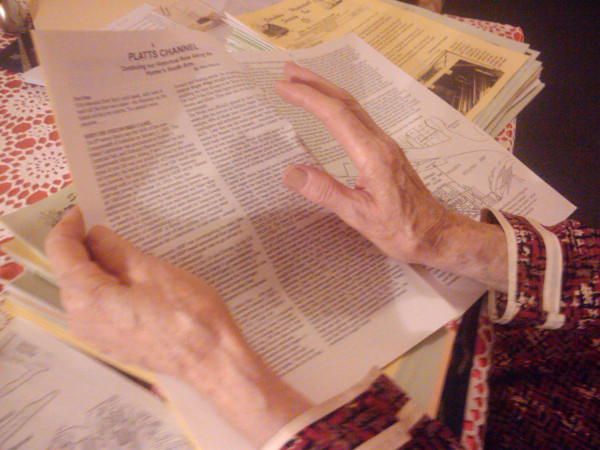
Vera Deacon is an island girl. She grew up on Dempsey and Mosquito islands – islands that no longer exist. (They have been covered in slag and turned into Kooragang Island). As a young woman she was always on the water rowing everywhere, along the channel, between the islands and to work at Mayfield. Her hands can be seen above – boatrower’s hands.

And Helen Marshall (who helped create the Mayfield walks) http://libguides.newcastle.edu.au/content.php?pid=251354&sid=2089250 has a prodigious memory going back to around 1933. Helen has been marvellous in helping  me map out three walks that my main characters Miss Summerville and Adrian Langley take in my novel The Grey Silk Purse. We have had some wonderful discussions about Waratah House and Argyle House, two properties that have been demolished years ago. We have also talked about the colour of Platts Channel, the way a gate faced surrounding Argyle House, also the Black Wharf off Ingall Street and Shelly Beach (both long gone). I only hope I can do her and Vera’s memories justice.

More Heroic Women

Now that my main character has just stepped ashore in England (on the 28th November, 1917) I have switched my research to find out more about the last year of the war. Along the way I have met more heroic women. I am only a third of the way through Women on the Warpath by David Mitchell but within the pages of this book I have already met some wonderful, inspiring women:

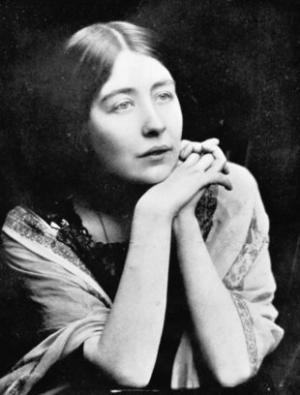
The indefatigable Pankhursts who took on Womens Suffrage (of course), the Huns and the Bolsheviks, particularly Sylvia who worked tirelessly for poverty stricken women in the East End of  London, among many other good works. Lady Muriel Paget who formed a hospital unit  that was sent to Russia. Lady Leila Paget who organised a hospital unit in Serbia and liaissed with the Bulgarians to open an emergency clinic in Skopje.
Sarah Macnaughton  who set up a soup kitchen at Furnes in Flanders and Mrs. St Clair Stobart who was the leader of a coloumn through the terrible Serbian Death March of late 1915.

One of my aims in writing The Grey Silk Purse is to highlight what it was like during WWI for women with a driving need to help others. It was a time when women really made a difference. Opportunities arose because of the war and the shortage of men, and these amazing woman and thousands more grabbed life with both hands and achieved startling results.

The Ostrovo Unit

Well, the mystery surrounding the massacre of what I’m guessing was an outpost of the Ostrovo unit, has deepened. No more details via Stella Miles Franklin and nothing at all in the biography of Dr Agnes Bennett by Cecil and Celia Manson. Nothing either in a referenced work Australians and Greeks, Volume 2 by Hugh Gilchrist. But it doesn’t really matter as I’m fairly sure the event occurred towards the end of 1917 – well before my characer arrives on the scene. Still it would help my writing to understand the historical context and how such a thing happened.

Despite this slight setback, I have actually been picking up some very interesting facts and historical details along the way: information about the day to day running of the unit, the politeness and old world charm of the Serbian officers, the large numbers of  Australian women who were doing war work at the Macedonian Front. Even the odd Serbian word as well, which may prove useful if my heroine happens to fall in love with a Serbian orderly. It’s a possibility!

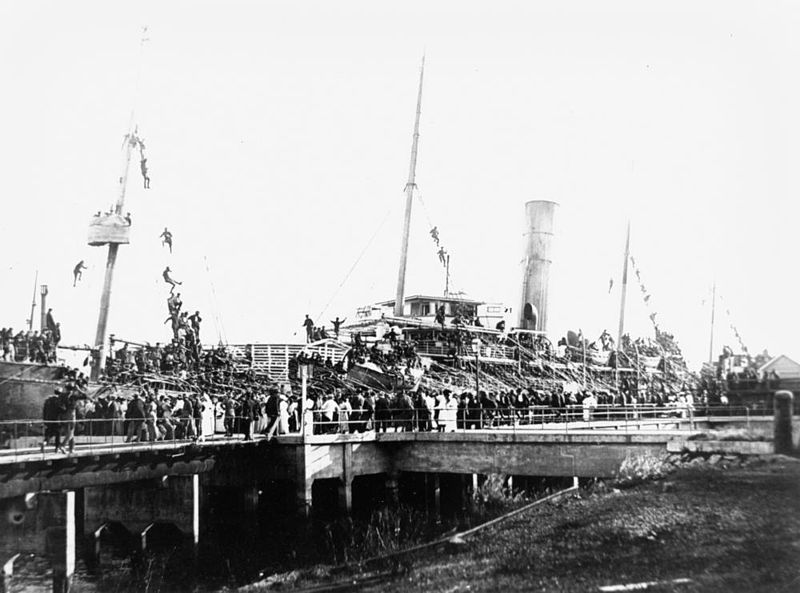
At the moment my girl is still on board HMAT Kanowna which has recently (October, 1917) stopped off at Durban and Cape Town. At this very moment (well today as far as  my writing goes – actually 15th November, 1917) she has just spent a few hours wandering around Sierra Leone before she must embark for the last leg of her voyage to England and a confrontation with her difficult aunt. Will post again when she arrives in London.

It’s a mystery

After posting my last blog a mystery has developed. On Saturday 13th July I spent the day at the Mitchell, after first viewing the World Press photos and the SMH Photos1440 http://www.sl.nsw.gov.au/events/exhibitions/2010/photos_1440/items/image05.html I went carefully through A History of the Scottish Women’s Hospitals by Eva Shaw McLaren looking for a reference to the tragedy at the Ostrovo Unit. Nothing. Just a mention of the unit being moved. Now I know from our excellent historian Susanna De Vries’s book Heroic Australian Women in War, in a chapter on Agnes Bennett and Lilian Cooper, that the skeleton staff of the unit were massacred by the Bulgarians and our very own Miles Franklin was referenced. I am waiting for my local library to get a copy of De Vries book that features Miles Franklin – The Complete Book of Great Australian Women for more details.

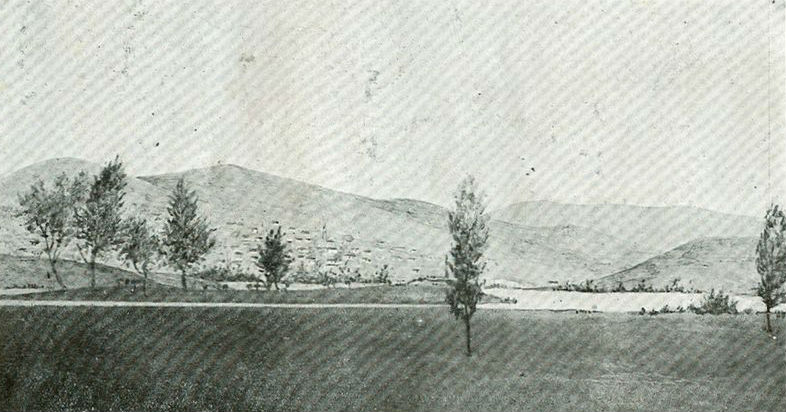
In the meantime I decided to go back again yesterday to the Mitchell and had a very interesting day. I went through two old directories (1914 and 1919) of the Newcastle, Cessnock, Maitland districts and also leafed through Flora Sandes’s two autobiographies. Sandes was the first woman to be commissioned as an officer in the Serbian Army. http://en.wikipedia.org/wiki/Flora_Sandes I also went through Stebbing’s At the Serbian Front in Macedonia – again no details of the massacre of the unit. The mystery deepens.

Lastly I went through the 1917 diary of Miles Franklin which proved to be fascinating – particularly descriptions of the camp. Matron was a terror evidently and the work in the kitchen exhausting. Unfortunately I ran out of time to read the 1918 diaries but am  looking forward to reading the chapter on MF in De Vries’s book and delving deeper into what happened to the unit.