Keeping track of the chapters you’ve written

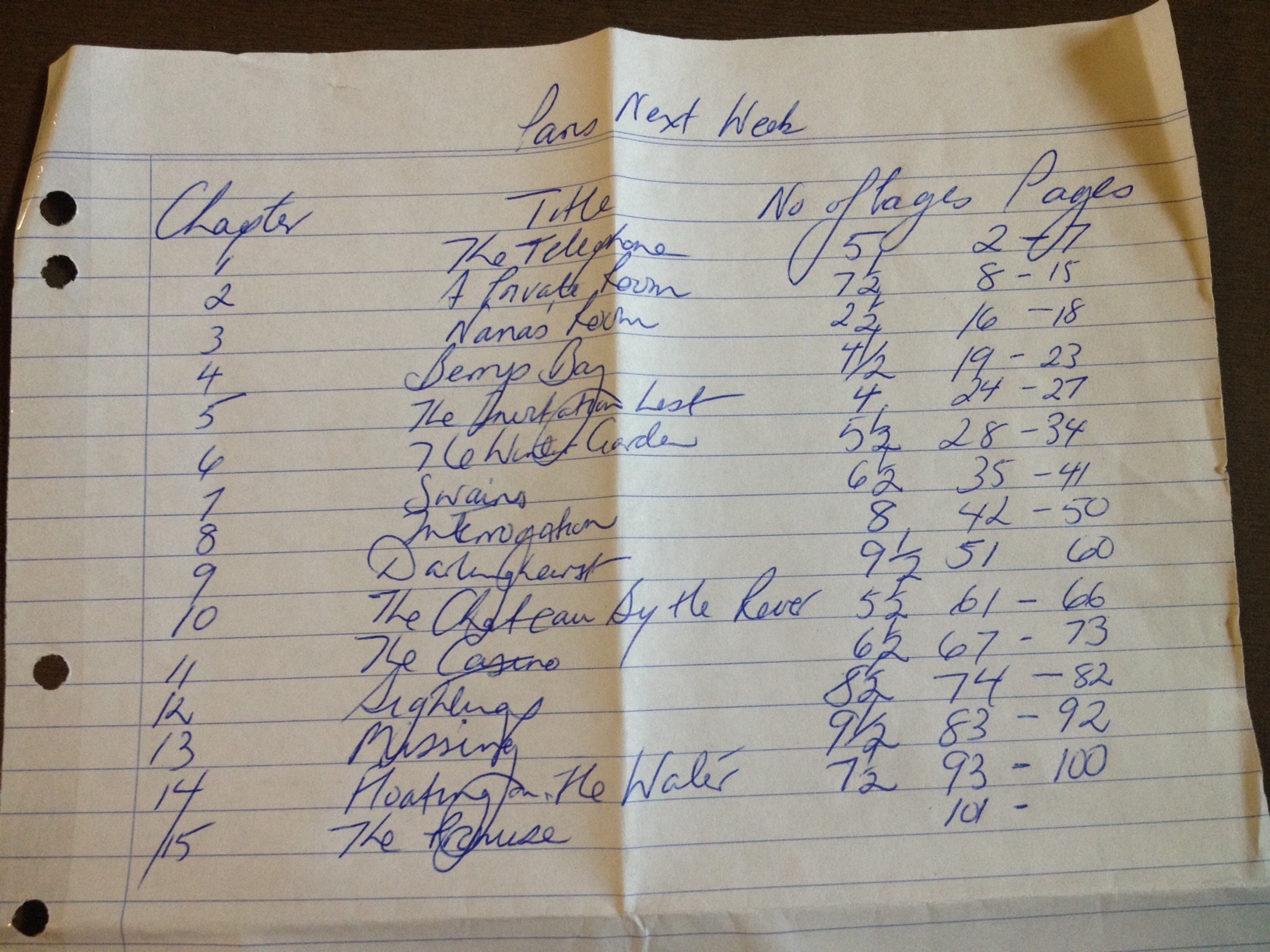
chaptersHello, I’m back! The mistress of old school. The beauty of this piece of paper is that all the chapters (or most of them) are visible at a glance. Writing programs will obviously show much more but that can be distracting. Along with my notebook and my record of pages written (see previous post) this is actually all the paper I deal with in writing. The rest is on my laptop. Oh and one draft I print out and edit on paper.

I usually keep this record only on my first draft and my last. The chapter list not only helps me keep a track of my chapters but the length of them. Luckily for me I name my chapters and by looking at the list I can see, for instance, that The Casino is 6 1/2 pages and Berry’s Bay is only 4 1/2. I can also look at the flow of the scenes. Generally, for me anyway, a chapter that is a bit short is often a problem chapter and needs more attention. The Winter Garden, for instance, does seem to be a bit short to me when I consider what happens in that chapter and the page count of the others.

Everyone is different in how they write of course but for me this list is too impractical for the next few drafts. My second, third and fourth drafts are the ones where I’m constantly adding or deleting pages. Therefore it would drive me (and most people) mad writing such a record out each time.

For the last draft though, it is very useful. I generally write it out again noting the changes in the chapters and also adding a word count for each chapter which gives me a final manuscript tally. If you don’t already keep such a record you might find it handy! I would love to hear what types of writing records you keep!


Coping with the rejection of your manuscript

GallianoYep, that’s what I’m doing. I’m back on the merry-go-round. Just received my first rejection for my current manuscript The Grey Silk Purse. And already resorted to drink! One bourbon and coke down and the Galliano pictured to go! Coping mechanism No. 1. Have a drink. That’s one strategy and being very generous of spirit, although down (but not beaten) I am going to offer some more.

2. Adopt a mantra. I submitted my first piece of writing way back in 1981 but it wasn’t until sometime after 1996 when I watched The Cable Guy and Carey said those marvellous words “Allrightee then!” that I adopted a mantra. I still repeat those eloquent words to myself on being rejected. I find they are very helpful, being such a mix of frustration and, dare I say, bloody-mindedness, that they sum up my feelings exactly and are very soothing.

3. Begin another project. As readers of this blog will know that’s what I’ve already done. I tell you, Paris is looking pretty good at the moment! I’d rather be writing about it than trying to work out where to send my manuscript next. But then maybe that’s why I still haven’t found a mainstream publisher for my novels. I tend to submit a handful of times and then retreat into a hole – generally the world of the first half of the 20th century. Each one of us has our own coping mechanisms, I guess, but obviously breaking through does require perhaps that one last gasp of air – that garganturan lunge to the finish line. Maybe I’m still ambling. How are you going?

4. Whinge to friends. This is a good one. Twitter and facebook friends are excellent. You can’t see them looking around for a means of escape and only those that feel like lending a friendly ear will respond to your tweets and posts.

5. Regroup. I do find that after a rejection (at least in the early stages of submitting) I am pushed back to have another look at the manuscript. This is my method of regrouping. After yesterday’s rejection I read for the 101st time, the crucial first page. I decided again, that yes, the manuscript did need a prologue but I slashed a few sentences. They were phrases that I had hesitated over previously. They are gone now and the first page is much cleaner.

6. Do not speculate! I’ve done it in the past, you know: “Oh why didn’t they accept my manuscript? Was it because of this, or that or maybe…etc. etc.” Don’t! It is a complete waste of time. Put your frustrated energy into something else. Maybe an idea for a co-operative, start up a meeting of like-minded friends or go to a workshop. Catch up with relatives or see a movie or a play. Anything is better than beating yourself up about it.

These are just a few suggestion. I hope they help. If you are wandering around in the wilderness, like I am, I would love to hear yours!

Writing the final draft of your novel…or maybe the second last draft

Words taking flight!

Words taking flight!

Sometimes it’s hard to tell! I’m currently on the 4th draft of The Grey Silk Purse. I believe it is the second last draft but then I thought the 5th draft of Tomaree was the last way back in around 2004. The last was actually finished (the 8th) in 2008 so you see it’s a tricky business!

Ideally, of course, when a writer believes they are on the home stretch they should put the manuscript away for a few months and only then have another look before completing the final draft. I wish! I’d love to have the luxury of being able to do that but, frankly, I would go mad! Not writing is not a option for me!

An alternative the experts say is a change of scene. Wouldn’t a European trip be lovely? Paris, Rome, several mountains in Switzerland, a week in Venice. A mediterranean cruise I’m sure would clear a few cobwebs. One can dream!!

Crossing out those two options, what can be done to clear the air so that we can approach our manuscript with fresh eyes? My suggestion and what I am currently doing is:

Read someone who writes completely differently from ourselves; preferably someone whose style, sentence constructions, choice of subject matter is alien. 

Immediately for me two writers step forward. The first is Philip Roth. In my review of The Human Stain I talk about what it is like to read a Philip Roth. It is like being picked up by the scruff of the neck and dragged along. You can kick and scream against the intensity and speed that you are travelling but somehow you just can’t put the book down.

The other writer is John Banville. In his magnificent novel The Sea the reader is relentlessly tossed and scoured by his prose which sweeps the reader from the shore to the depths of the ocean, often dragged mercilessly under to surface gasping for breath.

Either of these writers will do nicely to give me a fresh eye! I chose John Banville and here is my review of Eclipse, the first book in his Alexander Cleave trilogy.

Eclipse by John Banville

I’m not sure if I’ll make it through the other two books before going back to The Grey Silk Purse but I will try!