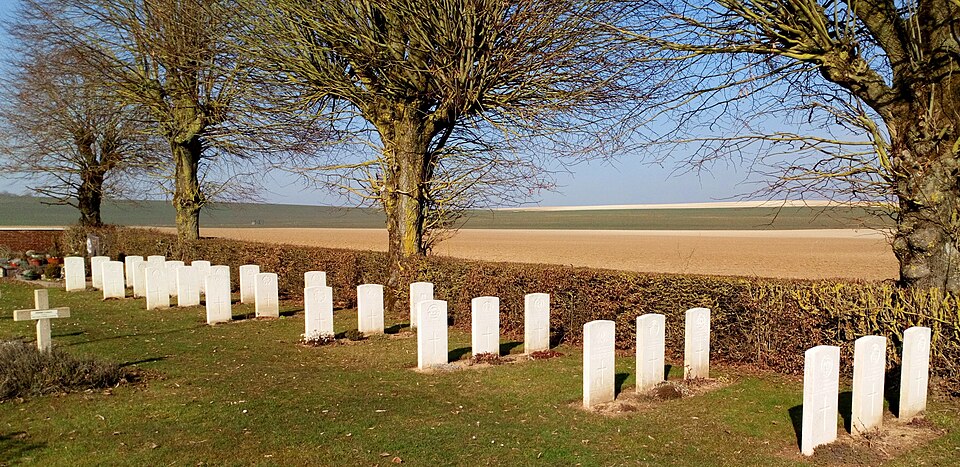
Dreading visiting the Grave

Image courtesy of Wikimedia Commons

For the first time in over thirty years of writing long prose I have actually taken a moment to make a note of the last few planned chapters of this manuscript I am now calling Towards Paris. It is the second manuscript featuring Sarah Montague in a possible planned series. She first appears in Tomaree as a secondary character in 1942, but for this second book set in the 1920s it is 1924 and she is the star. This book has the working title of Towards Paris.The first book has the working title of Paris Next Week.

Here are the planned last few chapter titles in Towards Paris. The first one I am three pages into:

Another Two Lists
The Grave
Derbyshire
The Voyage Home
Highcliffe

Instead of researching the Dernancourt Communal Cemetery, I am working out an itinerary for a short trip around a few Derbyshire towns. I am looking at photos of Bakewell and Ashbourne instead of trying to work out what would be written on her brother’s headstone, other than name and rank. I can’t seem to tackle the reality of visiting such a place, even in my imagination.

Just like Sarah, I’d rather be anywhere but at the cemetery, facing her grief and loss. For anyone, even a fictional character, it is tough to visit the battlefields and cemeteries of WWI and WW2. I don’t know how immediate families managed it.

Trouble with palm trees

Image courtesy of the State Library of New South Wales

So, I have spent a ridiculous amount of time today trying to find out when the palm trees in Bridge Street were removed. I’ve been through blogs, endless google searches, at least an hour at the City of Sydney Archives, eBay, Alamy you name it. It sounds trivial but I need to know the date so that I can place a flash I have written, chronologically, in my collection. For the moment their loss features in my just written flash but now I’m obsessed with the when.

I had heart failure earlier in the day when I found a postcard featuring the palms dated 1958, a date that completely rules out the flash from being included in my collection. But I’ve since found the photo below dated by the Sydney Archives as 1954 with no palm trees. So hopefully the trees were removed sometime in the early 1950s. It’s strange but there are not very many photos of the street in the 1940s. Because of the war perhaps?

You will see that the distinctive Burns Philp building features in both photos. I have also “asked a librarian” at the State Library the question so I will keep you posted on the outcome. In the meantime I’ll probably still be searching in my sleep.

Image courtesy of the City of Sydney Archives

Update: I heard from Kate, a librarian at the State Library, on the 22nd December and she confirmed through various newspaper articles that she found in Trove that the palm trees were chopped down in August, 1946. I’m not sure what I did wrong when searching Trove but I had no luck even though I tried “Any of these words” and “All of these words” for palm trees Bridge Street. Here is a small newspaper article:

Image courtesy of Daily Telegraph 26/8/46

And time marches on and over the intervening years so many more trees have been cut down in the name of progress.

The act of researching – time, place and memory

Chateau Chalon

Image – artwork by Maureen Boyle

About two years ago I bought a photographic print by Maureen Boyle. She had quite a lot of prints on display – small and large of photographs she had taken in France and I was taking my time choosing. After all, I was aware that I might be selecting an image for a scene or scenes of a manuscript not yet written. I asked her endless questions. Some scenes were of Paris, from memory, others were taken in the Jura region and several of a chateau were what particularly drew me.

But let me step back a little. In November 2013 an idea came to me about writing the earlier history of a character that appears in my novel Tomaree. She would be nineteen or twenty in the year 1924 and we would find out what happened to her in those early years to shape the character she would become in 1942. In 2015 I realised that I was possibly writing several books and that in the next book Sarah would travel to Paris and research the movements of her grandmother in the 1870s. I knew that a chateau would feature in the second novel but where would the chateau be and what would it look like?

A chateau not far from Paris fascinated me but then I discovered Maureen’s photos of Chateau Chalon in the Jura district of Eastern France. I looked at several, well I think I did, of the chateau and finally selected a white framed print 8 x 5. I think it is a marvellous photo, put it in my spare room and promptly forgot about it.

Life intervened, as it always does and I didn’t finish the first full draft of Paris Next Week until a week before Christmas last year. I am now embarking on a second draft – tidying up the prose and checking some 281 points of research that need to be verified, expanded on or simply deleted because they are not relevant to the 1920s. I.e. “comes a cropper”; I hash tagged this remark made by my character Christopher Hyatt as I wasn’t sure how old it was. Turns out it’s pretty old and safe for my character to say. Hastag deleted. Current count is 247.

Back to the photograph. On the evening of Bastille Day, at the French Friday markets in Newcastle I met Maureen again and went through her photographs. I picked up one of the chateau and I told her that I had bought possibly the same chateau, but from another angle. She said she had taken a lot of photos that day. As I studied the photograph she showed me the same photo but much larger. Excited I bought the larger photo. The details were so much clearer of course. Not only was there a little Juliet balcony but a small enclosed tower next to it. I took the photo home that night and yes, you guessed it, I had bought the same photo.

No, I don’t have a bad memory. I have a particularly good visual memory. It just seemed to me as I contemplated the photograph for the second time that it was a different photograph. I was of course seeing it with new eyes. I like to think that this is a nudge to look much closer at something that has become an everyday part of my life. After this, it will be very hard now to chose another chateau.

PS I’ve just discovered that this is a photo of a house near the Chateau. More digging is now obviously required.

The slow progress of a first draft

Pages written 1

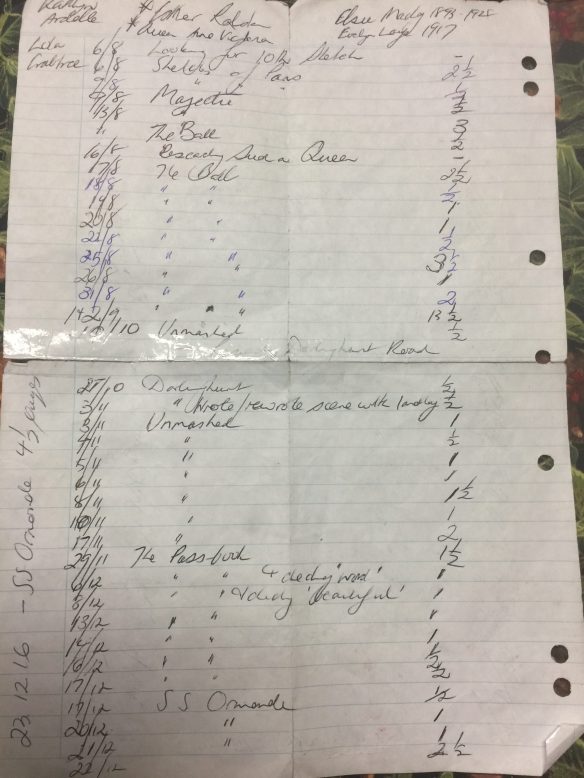
Well, as you can see it’s a very crumpled messy piece of paper but it is the start of my manuscript with the working title of Paris Next Week. As you can also see the first two and a half pages were written over three years ago on the 5/8/2013. Being Australian that means the 5 August not the 8 May. On the 25/2/2014 I ended up with 43 and a half pages. Not a bad start but overall the slowest first draft I’ve ever written, However keeping a record such as this does help remind me of several things.

Firstly, as you can see near the top of the page there is a gap of three months. Not sure why now but probably had to stop and really think about what was happening with the novel and to check that I was heading in the right direction after the excitement of getting those first five pages down.

Secondly I can see now where I took breaks of over a week or two for research. These are breaks that I couldn’t be avoided by using hashtags (see my earlier posts). In May 2014 I took two weeks off looking for a suitable chateau by a river in France. In early October of the same year I took a week or so off researching Kings Cross. And then from late October 2014 to early July 2015 I didn’t write a page. I was doing a major rewrite of a previous manuscript for a couple of months and then during the first half of 2015 I was quite ill suffering from a severe flareup of eczema.

During 2015 and early this year I also wrote three short stories featuring a brand new character called Zach. More breaks to research Sydney Theatres and quite a long break researching 1920s actresses and their famous roles and also looking for 10 locations that my main character Sarah’s grandmother would have been tempted to sketch in the 1860s in Paris. Whew!

Pages written 4

Above is the home run with the very last entry written sidewise just last week, 4 and a half pages finishing the final chapter entitled S S Ormonde. I also did some editing checks and eliminated two words that I used a frightening number of times – one was the word ‘word’ and the other ‘beautiful’. I’ll be doing a lot more of this type of editing in the next draft but these two jumped out at me and I felt compelled to reduce them drastically.

And this is what makes it all worth while. A list of all the chapters and a rough page count.

List of chapters

35 chapters, 255 pages and 70,687 words. The page numbers are pretty much screwed after chapter 27 because I did add a page here and a page there to some scenes that had to be rewritten but it is close enough. This sheet is one thing I don’t keep up for the next few drafts as the manuscript is in a state of flux with rewriting and researching going on but I do tend to write another one of these up for the final draft.

Would love to hear how you all keep a record of your drafts. Probably not as old fashioned as this but the result will be the same – words into sentences, paragraphs into scenes, transformed into chapters to form a complete first draft of a manuscript. Happy writing and a Happy New Year!

A writing life: happy accidents and how they occur

le_train_bleu_by_vincent_van_gogh

Le Train Bleu by Vincent Van Gogh Source: Wikimedia Commons

This is how it happens. I am currently reading a beautifully written book about Agatha Christie’s disappearance in December 1926 entitled On the Blue Train by Kristel Thornell. It’s a subject that has fascinated me since reading Agatha Christie’s autobiography and the possibility that the famous author suffered from a rare form of memory loss – the fugue state. Her disappearance is an incident that Christie barely referred to afterwards and never explained. I’ve only now just found out that Miss Marple first appeared in a short story in 1927. I find this telling. An alter ego created to help her cope with the disintegration of her marriage which precipitated her flight in the first place? We’ll never know of course but Thornell offers up what might have happened during those eleven days.

I thought at first that the title referred to depression – the blue train of depression. An odd expression that I had never heard of but early in Thornell’s book there is mention of a novel set on a train that Christie was working on at the time of her disappearance.Two days ago I googled The Blue Train and discovered Le Train Bleu.

“The Calais-Mediterranee Express was a luxury French night express train which operated from 1886 to 2003. It gained international fame as the preferred train of wealthy and famous passengers between Calais and the French Riviera in the two decades before World War II. It was colloquially referred to as Le Train Bleu in French… and The Blue Train in English because of its dark blue sleeping cars.”

Perfect! I am so excited by this. I am right now nearing the end of the first draft of my manuscript set in Sydney in the 1920s. In another manuscript I’m hoping she will find her way to Paris where her best friend Louise is now living with her husband, a Russian Jew named Lucien Grinberg.

This is what makes writing so exciting, a discovery like this. I now need to find out how I can get her on that train and visiting the Riviera, obviously spending time celebrating her freedom. Back to F Scott Fitzgerald who has written some wonderful stories about the rich and famous, my favourite Love in the Night is actually set in the French Riviera in the 1920s. May all the writers reading this blog have lots of happy accidents or synchronicity as I prefer to call it.

Researching Paris and/or another early poem

640px-Boulevard_du_Temple

Image source: Wikimedia Commons

I’m researching Paris in the 1870s and don’t quite know where to start. What part of Paris would a young Australian girl live in during that time? Paris is the early part of a Grand Tour of Europe that Lena Dubois is enjoying when her mother dies suddenly. She is alone in a strange city with only a smattering of French. What arrondissement does she end up living in and as an artist what buildings and landscapes would she chose to sketch? Fast forward to 1924 and ten of these sketches are now hanging up on the wall of her bedroom. But what are the sketches of? Now that’s the question and I’m having a lot of fun working on it.

To kick my research off, I’m currently reading a marvellous book called Paris: a journey through time by Leonard Pitt. Looking through the old photographs of Paris – Maubert and Saint-Severin, Boulevard Saint-Germain and Montagne Saint-Genevieve, From Odeon to Saint Germain-des-Pres, Rue Beaubourg and Nearby Streets, Rue Etienne-Marcel, Avenue de l’Opera and Les Halles reminded me of one of the most famous photographs of Paris – Boulevard du Temple, Paris, 1838. I was so intrigued by the photograph the first time I saw it that I wrote the poem below.

*BOULEVARD DU TEMPLE, PARIS, 1838

In the pages of a book I find
a shoeshiner and his customer
in the deserted street and where
are the doves? Cooing from the
windowsill near the photographer
now a long way from camera obscura
with this picture of a quiet
Paris street. What next? A view
of the Great Pyramid in albumen
and wet plates at the goldfields;
dead blue and grey soldiers
in black and white and now
moving pictures flicker past
until we have battlefields
in our living rooms: our square
argus-eyed friend always on
the spot. Yet I’d rather
discover beauty unadorned, know
the cameramen, the crew have all
gone home and left me to contemplate
how time has slipped away
from a quiet Paris street.

*First published in Muse 

Researching v. Writing and/or maximising your writing time

Researching vs. WritingSometimes life gets the better of us – looking for or starting a new job, the birth of a grandchild, even a scene that you can’t find inspiration for and your writing stalls. This is when those pesky hashtags come into their own.

You may only now be adding them to your draft. Ideally it is best to add them from the very first draft but better late than never, as the old cliche goes. See my earlier post. Either way you should now have a general idea of things you need to check. That’s when it’s handy to make lists and start borrowing books on those subjects when the writing isn’t flowing.

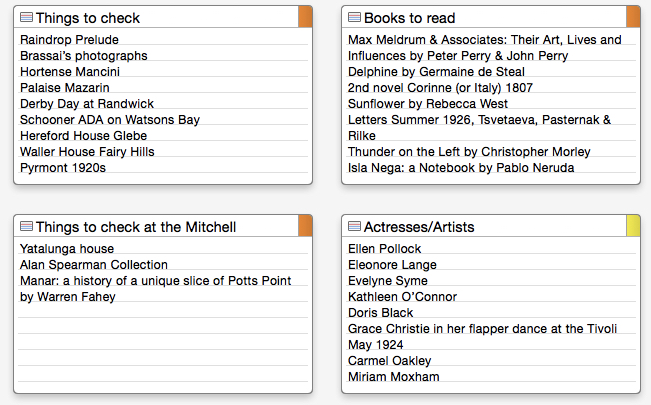
My local library know me as that strange woman who orders the oddest books on inter-library loans. Here’s four of my lists above. A lot of the books on the TO READ list will be interesting to skim through but they may not get rid of a single hashtag. They may, though, supply me with an idea or a possible scene.

I recently leafed through a marvellous book on Art Nouveau by Judith Miller. In it I found a marquetry side table, a silk panel and a glass carafe with a bird on the lid. I also found an amazing lamp with a bird pattern on it, a sea green glass vase, a brooch featuring a two swans interlocked and a bronze nude seemingly wading through rushes.

In the book there were details of each item, the country of origin, the artist and the year. These details, of course, DON’T go into the manuscript. But they are a guide for me as to whether they are suitable or not. What goes in is what my character Sarah sees at Lilith’s flat or what the family might call treasured objects such as the lamp or the brooch. i.e the swan brooch and the bird lamp. Sarah might recognise some things of course – that a side table is marquetry but she is not a specialist on furniture and art of the art nouveau period, although this is the period her mother might have been doing a lot of buying for the family home.

Armed with this new information on furniture and objects, I dealt a death blow to three hashtags in Lilith’s apartment. One of the objects was a lamp. I then searched lamp in my manuscript and discovered another hashtag #acetylene lamp. After some quick hunting I decided what I really wanted was a kerosene lantern. Bingo, another # bites the dust. I then worked on a hashtag relating to an outdoor lamp. I googled a few pictures and chose a square lamp for a porch light and then on the spur of the moment got rid of #easy chair and replaced it with a walnut armchair. Six hashtags gone! That leaves 222 to go. Now back to that fancy dress ball.

How fiction/historical fiction can save historical fact

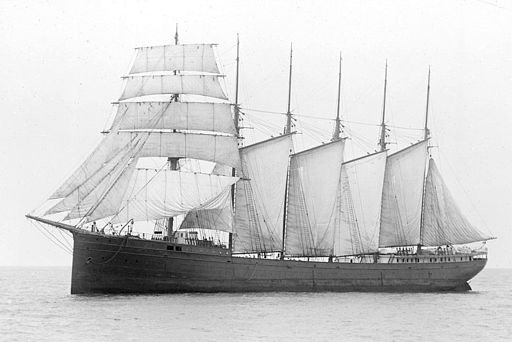
Barquentine City of Sydney – formerly steamer City-of-Sydney_SLV_Green, Source: State Library of Victoria Author: Allan C. Green 1878 – 1954

From oblivion is what I mean. One of my main aims in being a writer is to preserve little known facts and make them sing in my fiction. I might have touched on this before but there were two facts (above all others) that I wanted to preserve in Tomaree and that was to do with the US servicemen based in Australia. But let me start at the beginning.

Tomaree is inspired not just by a real life love story but by a fascinating time in Australian history when approximately half a million US serviceman were stationed in Australia during World War II. There are a lot of facts in Tomaree – details of the Fly Point camp, the way Nelson Bay used to be in 1942 (just a jumble of small shops) details of campaigns in the Pacific and much more. But the two facts, that may seem trivial, but I wanted to include are: 1. that the American serviceman hated all our loose change. They couldn’t abide it heavy and jingling in their pockets – the threepenny, halfpenny, pennies etc. As related to me by a Nelson Bay Resident, the soldiers would dig their hands in their pockets offer up the change to the nearest small child and say, “Here kid, buy yourself an icecream.”

No. 2 is that wherever the soldiers were stationed in Australia, it was common for local residents to send a small boy (never a girl from what I read in a history book on the subject) into the street looking for a Yank to invite him home to tea. My Amercan Signals Officer is approached by such a small boy but has to refuse because he already has a dinner invitation. I feel very privileged to have the means to keep these sort of little known but important facts alive for the reading public of today. It’s what motivates me to seek out historical fact (like many historical fiction authors I’m guessing) and weave it into my fiction.

In a strange way too, fiction also preserves historical facts for readers. For some time now I’ve been researching Sydney in the 1920s. There are actually not many non fiction books available on the subject. Frustrated, I turned my attention to fiction but wondered where all the female fiction writers were who were writing at that time. There didn’t seem to be many listed in anthologies and literary records. At first I thought there was simply no significant female authors writing during the first two decades of the last century. I have since read Dale Spender’s Writing a New World and discovered that is not the case. They have been deliberately left out of literary collections and reviews – but that’s another blog. In this one I want to highlight how I have found historical fact in fiction.

As mentioned I turned my attention to fiction to help me research the 1920s and luckily discovered Ethel Turner’s daughter Jean Curlewis. Last month I read her third novel Beach Beyond set near Palm Beach and written in 1923. This week I have just finished her first novel written in 1921 – The Ship That Never Set Sail. Here is what I have been looking for the last six months – a real, vibrant Sydney – the Sydney of 90 years ago!

Here she is writing about Darling Harbour:

“They were gazing right down on to the littered decks of ships – they could almost have dropped pebbles into the holds – they caught intimate glimpses of donkey-engines and capstans and flying bridges and fo’c’stle hatches at a proximity impossible at the Quay. The huge funnels towered up right beside them. They could count the cases and barrels and mysterious bulging sacks and great green clusters of bananas scattered on the wharves – gaze down into the dull green water, deep-hued as a peacock’s tail with a film of oil from some passing steamer. All the vast detail of the fifth port of the Empire was spread beneath their eyes: “the beauty and mystery of the ships”; all Darling Harbour stretching like a river between its vessel-teeming banks into the very heart of the city.” Marvellous and better than any history book!

There are also descriptions of White City, now long vanished, a ball on board a warship, something called a gypsy tea, the Blue Mountains when it was smaller and quieter with barely any cars on the road, and Pittwater. A wharf at Newport is mentioned and a pier “that ran out from a green garden full of white pigeons, scented verbena and mauve blue Love-in-a-Mist.” This is very near where I used to live but of course the garden is long gone. I’m so thankful to have found Jean Curlewis. Her words have been helping me to recreate in my mind another Sydney. I hope to track down more lost authors, to read, review and discover the Australia they lived in.
Playing Musical Chairs With Sydney Suburbs

`Greenoaks',_Darling_Point,_1895

Greenoaks, Darling Point 1895. Source: Federation House Wikispaces

I can do this! I’m a novelist! But why? Now that’s a good question but I’d better start at the beginning. As I might have mentioned, I had barely done any research when I began writing my manuscript Paris Next Week last August. I needed two Sydney suburbs fairly close to the inner city so I chose Elizabeth Bay for Louie Galbraith and Darling Point for my main character, Sarah Montague. I actually can’t remember why but with this decision I had put my main character further away from Sydney and all that was happening there.

This wasn’t a problem until I started moving my characters around the city and also became better acquainted with them. It turns out that Louie’s family are richer than the Montagues and she therefore has a more generous allowance than Sarah. She also has a chauffeur at her disposal. Sarah is forced to sometimes catch the tram (poor darling) and often walks to some of her meetings with her best friend. This is a bit of a stretch if she was walking from Darling Point – an hour as opposed to the more realistic thirty minutes from Elizabeth Bay.

Recently I have been investigating the mansions of both suburbs. Libby Watters at the Woollahra Local History Centre has been a wonderful help. With a map and a list of Darling Point mansions she supplied, I have discovered that Darllng Point is the grander suburb, with several outstanding properties such as the fairytale Greenoaks above. It’s one of four spectacular castle like houses in the suburb, including the amazing mansion called The Swifts. I grabbed this for Louie’s home only the other week and with this decision and the chauffeur, I decided to swap the girls’ suburbs. Once I had the extra wealth and the suburb, AND the castle here is the paragraph that came from all the manoeuvring. It is Sarah pondering on Louie’s house I’ve called Eastbourne (The Swifts in disguise) :

“It has crenellations everywhere, ready for battle with little chimneys shaped like turrets and a portico that could shelter a whole wedding party in a thunderstorm.  It is an amazing house masquerading as a castle in Scotland and the magnificence of it has always shadowed Louie in a way. It’s strange that I should only have just realised this but it is what I’ve been thinking since our talk at Darlinghurst.

She loves the house and grounds. I know she does but she also fears what the house represents. I can’t blame her! I’m thankful I don’t live there because I’m sure I would feel the same way and I think that’s why we always played at Highcliffe when we could. Not just because we loved clambering up and down the switchback stairs to the garden. We used to get to the bottom and look up. And although Highcliffe looks the most impressive from that view, it still manages to look friendly rather than imposing. Whereas Eastbourne does imposing AND grand exceedingly well. What daughter could look up to that? And what sort of man does the house call to? The wrong sort of man, I’m sure. The sort that says to himself, “Ah, here is money to burn.””

The suburbs are now aligned and all is right with the world of my characters. At least for the time being!


Lost – Elizabeth Bay Mansions. Found – the artwork of Gladys Owen

View from Darling Pt across Rushcutters Bay to Elizabeth Bay

View from Darling Point across Rushcutters Bay to the Elizabeth Bay mansions 1879 – source City of Sydney Image Library

Yep! This photo above has caused me a lot of grief. But let me start at the beginning. I am currently researching high society in Sydney during the 1920s. Until recently I thought (naively as it turns out) that I could simply read up about the wealthy and then fashion up a house and lifestyle for my main characters. Sounds simple, doesn’t it? How wrong was I!

This is a black hole in our history. Our novelists were not writing a Sydney Great Gatsby – they were, for the most part, writing about life in the bush. Later, the subject has hardly been touched on, which has impacted on the amount of research I now have to do. I was just realising all this a few weeks back when I decided I might have to look into the history of houses in the area to pinpoint and research the lifestyles and choices of the people (particularly the daughters) that lived in them.

Tantalisingly all these high society people are floating around in Trove in gay abandon. They are having farewell parties (off to the Continent, San Francisco, Hawaii). Hosting charity functions, balls, afternoon tea parties, enjoying the sea breeze at Hotel Cecil, Cronulla and all manner of other social activities. I swear they travelled and partied more than we do but what did they do day after day? How were the hours in their day actually filled when you were wealthy (you weren’t travelling on the Continent) and you didn’t need to work? Enter the picture above.

I chose five houses in the Elizabeth Bay area to research, working mainly on the images. It was late at night, I found this photo and reference to a short history of Ellizabeth Bay Mansions and being tired, I didn’t write the reference down – simply saved the photo. I thought I’d go back the next day and look into the reference. Could I find it the next day? OF COURSE NOT! The photo was there but no reference.

A few days later I visited the Mitchell Library and experienced first hand the very misguided changes that have been made to this historic library. Because of staff cuts, there were only two staff members on to help with people wanting to access the special collections. I was requesting maps of Darlinghurst Road in the 1920s and also looking for those notes on Elizabeth Bay Mansions. With the new changes to the Library I was told to put my requests in at the State only to find that what I wanted was at the Mitchell. I ended up going backwards and forwards between the two libraries four times.

I was very frazzled – almost as much as when I was Waiting for Eleanor Dark. In the confusion I missed requesting a book that I did come upon about Elizabeth Bay mansions. Another trip down to Sydney! But I did find the wonderful woodcuts and etchings of Gladys Owen. I was given an enormous folio tied with a ribbon and I was mesmerised going through images of Spain, Italy and England created between 1919 and 1960. This is what the Mitchell should be for. To look at special collections in the building where these collections are housed. It is with relief I heard that the recent changes and staff cuts are going to be reversed!