On Losing a Dear Friend

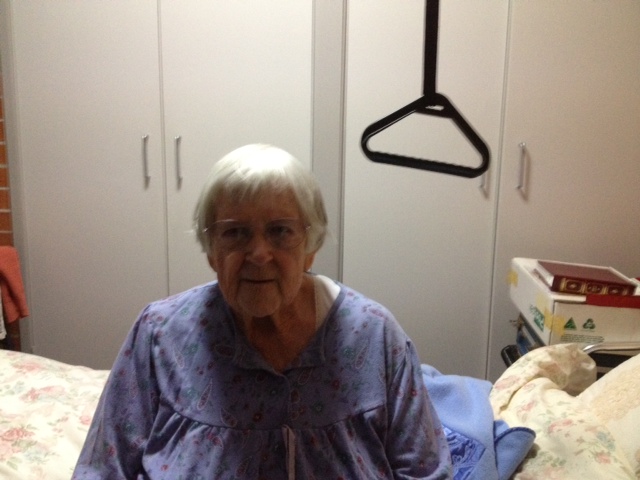
photoFrom the moment I started writing in the early 80s, talking to elderly people has been a very enjoyable part of my writing life. The first person I remember interviewing was a friend of the family of my first boyfriend. I was now a married woman (not to the first boyfriend) and beginning a novel that was later abandoned. From memory she was very interesting to talk to. (Her name escapes me now.) She had grown up in an old log cabin somewhere in the sticks and as a middle aged woman had written parodies of the romantic short stories featured in the Woman’s Day and the Woman’s Weekly at that time. The stories were actually accepted much to her amusement. I can’t remember her name but after our short interview I didn’t see her again.

In late 1982 or early 1983 I interviewed two wonderful WWI soldiers living in a retirement village in Collaroy.  One of them was a veritable minefield and I still have the notes I took from speaking with him. He was a sniper and told me some fascinating details not found in any history books. One interesting fact that concerned soldiers digging in under fire I actually used in my long short story The Running Lady published in Reveille in 1988.

In 2002 I was very lucky to be able to interview many elderly residents of Nelson Bay and Shoal Bay in regards to the US soldiers stationed there during WW2. At one stage I was driving up there once a fortnight to speak to someone about those fascinating times and I was always made to feel welcome. I think they enjoyed talking to me and I definitely enjoyed listening to them, including among many Mrs Blanch and Mrs Norburn.

In January 2010 I came up with the idea for a new novel and almost immediately I decided to set the novel, with the working title of The Grey Silk Purse, in Mayfield. I was unemployed for the first few weeks of that year and I spent a lot of time walking the streets and taking photos of beautiful old houses. I was also doing a lot of research on the net about the history of Mayfield. Two names repeatedly came up – Vera Deacon and Helen Marshall. I contacted Gionni di Gravio, the archivist at Newcastle University and asked him if it was okay to contact both of them. He said yes and told me where they lived.

I didn’t record the date I first rang Helen Marshall but we hit it off immediately and from May 2010 on I saw her quite regularly. I would visit her beautiful home in Elizabeth Street and mercilessly ask her questions. She loved talking about the old Mayfield and she would describe walks she went on with her father. I loved hearing about Mayfield as it was in the 30s and 40s and her memory was prodigious.

On one occasion she helped me map out a walk my character took near Platts Channel. She described in great detail a gate that led into the property of Argyle House (later the Murray Dwyer Orphanage). I explained what my character was doing. Helen described the gate for me, the latch and that there was lantana nearby. She could still remember the smell of the lantana. When I mentioned which way my heroine was walking home – up the steep slope by the side of the property to reach Bull Street – Helen told me that my heroine wouldn’t be opening the gate if she was going that way. I asked why and Helen explained that you only needed to open the gate to walk through the property if you were walking along by the channel. I was astonished that she could remember so much about a gate from around 1933 or so! I said as much and we had a good old laugh.

She also had very detailed memories of Waratah House which her father sketched before it was pulled down. On one of my visits Helen helped me mark out a map of the land near Platts Channel choosing the approximate location of Argyle House, Waratah House, the potteries, the ponds, the wheat field, a well and the dairy. (Not an easy feat with Industrial Drive and extensive industry transforming the landscape.)

Another day we actually designed the garden of the fictional house Summerville in Crebert Street. I still have the sketch in her hand. We also had some lovely talks over the Greg Ray books and an excellent book about the Middle East campaign of WWI. But apart from all this we were the best of friends. She wasn’t just an elderly lady with a fund of knowledge. She was someone that I knew I would have been life long best friends with in a parallel universe. As it was I only had less than three years to have lovely chats with Helen but I valued my time with her. I now miss her terribly.  Her quick wit and her kindness were a joy to me and I know it will take me quite some time to get used to the loss of her friendship. I can still hear her saying happily: “You clever girl!” or “You are devious!” when I explained some plot intricacies in my writing. I know she enjoyed our talks and I definitely did. I’m so grateful that I knew her, if only for a short time.

Writing the final draft of your novel…or maybe the second last draft

Words taking flight!

Words taking flight!

Sometimes it’s hard to tell! I’m currently on the 4th draft of The Grey Silk Purse. I believe it is the second last draft but then I thought the 5th draft of Tomaree was the last way back in around 2004. The last was actually finished (the 8th) in 2008 so you see it’s a tricky business!

Ideally, of course, when a writer believes they are on the home stretch they should put the manuscript away for a few months and only then have another look before completing the final draft. I wish! I’d love to have the luxury of being able to do that but, frankly, I would go mad! Not writing is not a option for me!

An alternative the experts say is a change of scene. Wouldn’t a European trip be lovely? Paris, Rome, several mountains in Switzerland, a week in Venice. A mediterranean cruise I’m sure would clear a few cobwebs. One can dream!!

Crossing out those two options, what can be done to clear the air so that we can approach our manuscript with fresh eyes? My suggestion and what I am currently doing is:

Read someone who writes completely differently from ourselves; preferably someone whose style, sentence constructions, choice of subject matter is alien. 

Immediately for me two writers step forward. The first is Philip Roth. In my review of The Human Stain I talk about what it is like to read a Philip Roth. It is like being picked up by the scruff of the neck and dragged along. You can kick and scream against the intensity and speed that you are travelling but somehow you just can’t put the book down.

The other writer is John Banville. In his magnificent novel The Sea the reader is relentlessly tossed and scoured by his prose which sweeps the reader from the shore to the depths of the ocean, often dragged mercilessly under to surface gasping for breath.

Either of these writers will do nicely to give me a fresh eye! I chose John Banville and here is my review of Eclipse, the first book in his Alexander Cleave trilogy.

Eclipse by John Banville

I’m not sure if I’ll make it through the other two books before going back to The Grey Silk Purse but I will try!

The Next Big Thing – The Grey Silk Purse

The Grey Silk Purse Notebooks

Here are four of my six notebooks for my current work in progress.

1) What is the working title of your current/next book?
My current work in progress is entitled The Grey Silk Purse and is set in 1917/1918 Serbia and Mayfield, Newcastle in 1920/1930.

2) Where did the idea come from?
Several years ago whilst doing book talks for Tomaree, a bookseller showed me a card advertising a New Year’s Eve party at the Trades Hall, Newcastle for 1930 run by The New Moon Dance Club. Whilst searching for more info about the mysterious club I came across a November, 1922 ad: “Lost yesterday Lady’s handbag between Elizabeth & Henry Streets, Tighes Hill along Port Waratah tramline or left in 6.42pm Port Waratah tram from Newcastle, contains 6 pounds, metal season railway ticket, keys etc. Finder handsomely rewarded on return to Miss Summerville, Room 5, Carrrington Chambers, Watt Street.”
I kept the name Miss Summerville but couldn’t find Carrington Chambers. Somehow I made the jump from there to my current project.

3) What genre does your book fall under?
Historical fiction

4) What actors would you choose to play the part of your characters in a movie rendition?
Strangely I have no idea for this one. I cast Crossing Paths though. The main characters were played (in my head) by Rose Byrne, John Cusack, Rupert Penryn-Jones, Miriam Margoyles and Helen Mirren (in an uncharacteristically timid role).

5) What is the one-sentence synopsis of your book?
It is January 1920 and Miss Summerville living in a beautiful house in Mayfield, Newcastle begins a diary detailing how, after a long illness, she has woken up and can’t remember the last two years of her life.

6) Will your book be self-published or represented by an agency?
I hope to finish the manuscript very soon. (I’m on the second last draft now.) I’m determined to find an agent and a mainstream publisher and that is my goal for 2013.

7) How long did it take you to write the first draft?
Much longer than Tomaree. Approximately two and a half years.

8) What other books would you compare this story to within your genre?
The Winter of the World by Carol Ann Lee
The Soldier’s Song by Alan Monaghan
Armistice by Nick Stafford

9) Who or what inspired you to write this book?
Heroic Australian women from both world wars, including Olive Kelso King, Alice Kitchen, Vivien Bullwinkel and Nancy Wake.

10) What else about the book might pique the reader’s interest?
Hopefully the wonderful Scottish Women’s Hospitals who ran 14 field hospitals during WWI. Many of their doctors, nurses and orderlies were Australian, including Stella Miles Franklin who worked at the Ostrovo Unit in Serbia, the unit featured in The Grey Silk Purse.
I’m now tagging three people to keep this meme going. They are:
Matthew Glenn Ward @ Matthew Glenn Ward
Anthony Wood @ Want For Words
Janna G. Noelle @ The Rules of Engagement
Happy writing!

My twitter community and why they are so important to me.

I went to the #NewyTwistmas party at Honeysuckle Thursday night attended by 60 plus and had a wonderful time meeting fellow peeps, most for the first time. I chatted to so many interesting people, including @CCLETS a dedicated potter, @whereismymuse a poet and @kimcoo and her husband who are relationship counsellors. It is a community that know me as a writer. That’s who I am – @lakelady2282, BookCrosser, author, amateur photographer. I tweet photos and the progress of my WWI novel The Grey Silk Purse. I also tweet/retweet about books, writing and history. That’s me!

To my friends and family, I am something else. With my family I’m mum and grandma. With my girlfriends I’m just a single woman in my fifties complaining about the lack of interesting men. (I have this theory that 75% of the single male population in their forties and fifties have been beamed to another planet and nobody’s noticed. But that’s another story.) My friends know I write but I don’t think they are aware of how much my writing means to me and in that sense they don’t know me.

My twitter people do. My wonderful Crossing Paths publisher @SkiveMagazine knows how important writing is to me and I love tweeting about his mag. The latest edition is an erotica collection so peeps get out there and buy it. Also @drdrdr09 knows. He became aware of how much I was agonising over finding an historically accurate way to get my main character from Le Havre to Salonika, late 1917 (avoiding submarines and nasty Germans). I tweeted in frustration to my twitter community and he stepped into the breach (WWI speak) and we had a fun time tweeting back and forth.

In my “normal” life, I mentioned to my friends the other day that I was having trouble with my epilogue. There was dead silence and then a change of conversation. In all fairness what can most non-writers say to such a statement? Some people would suggest a writing group. After all you get to sit down with “real” people and discuss writing problems but I’ve tried a few groups and they weren’t for me. (I once joined a screenplay writing group and one of the participants said, “I hate writing dialogue. Do you think that will be a problem for me?” She was serious). I didn’t go back.

For me twitter is my writing group, my photography group, my friends group, my “did you hear they found the cave from Island of the Blue Dolphins?” group. It is my arts world in a way that Facebook (that funny other social media with all the thumbs up things) has never been. It is where I’m lakelady2282 and it’s where on Friday morning I tweeted I had lost my job. I didn’t message my friends. I still – as of writing this article – haven’t posted it to Facebook. Without thinking I just tweeted. It was the community that I wanted to tell.

What I’m currently reading and/or am about to read or are on my bedside table.

Yes, I know it’s ridiculous but what can I say? And you haven’t seen my TBR (to be read) pile yet. I’m a bookcrosser – lakelady2282 at www.bookcrossing.com and things can get out of control. Goodreads – www.goodreads.com doesn’t help either. According to goodreads I am currently reading 8 books. Seven of those are pictured above and the eighth is Dracula which I began reading about two years ago whilst at work (at a job where there was nothing to do).

Wikisource http://en.wikipedia.org/wiki/Wikisource is wonderful for this. You open up the book on your computer screen, say The Scarlett Letter or Sense and Sensibility (making sure the chapter heading is not showing and it looks like you are reading some sort of detailed manual). Perfect! It’s how I read both the last two books.

As to the pile pictured above – well let’s see. I started The Facing Island by the historian  Jan Bassett ages ago. It is about WWI so it should be a priority to read but somehow I still haven’t got around to it. I know I will though.There’s With My Body by Nikki Gemmell which I keep interrupting to read other books, mainly because it’s too heavy to take to work (to read in my lunch break). And then as you will have spied by the familiar cover there is Fifty Shades of Grey by E L James which I have pretty much abandoned like a hell of a lot of other readers…evidently. I keep thinking I might get around to reading at least to the heavy BDSM section but always end up reading something else.

Also on the goodreads list is Early One Morning by Robert Ryan. The book is about SOE (Special Operations Executive) agents in WW2, a subject I’m really interested in and I should finish this book soon. Reveries of the Solitary Walker by Jean-Jacques Rousseau I began (before I finished any of the other seven) so I could send it out on the VBB (Virtual Book Bag) 1001 (1001 Books You Should Read Before You Die) being run by a lovely bookcrosser. There’s And So Forth an excellent collection of essays by the erudite Robert Dessaix (but I don’t always feel like reading essays so it’s still not finished). And lastly The Collected Wisdom of Florence Scovel Shinn which I dip into every now and then.

Now we come to the remainder of the books pictured. These are the ones I lugged home from Speers Point Library yesterday.I still need to research Australian nurses during the First World War so I borrowed Nightingales in the Mud by Marianne Barker. I am also currently trying to find a few books that my character Phyllis Summerville is reading and sharing with other passengers on board ship to England in September 1917. The 1001 book is useful for this. D H Lawrence is also very useful as I wanted a few risque books. The Rainbow seemed perfect until I found out it was banned for eleven years. I chose Sons and Lovers and his first novel The White Peacock (the small orange book, top of the right pile). I won’t use the latter. I’ll probably settle on Sons and Lovers for its shock value but I need to check this so will scan through the book. That’s three down of the second lot. I borrowed The Thirty-Nine Steps by John Buchan because that’s the book Phyllis actually chooses to read instead of the Lawrence (so now I need to re-read it). When I chose the Buchan book from the stacks out the back I discovered Singleton’s Mill next to it by an Australian author Sinclair Buchan. (It’s the book on the top of the left pile.) I just might have to read this book too.

The River Baptists I especially ordered from the library after hearing Belinda Castles speak at This Is Not Art last weekend in Newcastle. I googled her name and found out that this book is set in the Hawkesbury River, a place I know and love from my teenage years when my parents owned a Halvorsen cruiser. I am really looking forward to reading this book. It is high on my list to be finished first but its tied with the other book that was on display at the library entitled Why Not Say What Happened? a memoir by Ivana Lowell. Who can resist “a heartbreaking account of a gifted woman, her brilliant but destructive parents, and a glamourous, aristocratic life that was laced with arsenic”?

Certainly not me! So there is the complete list of the books pictured above which pretty much exemplifies my life at present – researching WWI whilst being distracted by sex (as such), the glamourous life (the grass is greener) and generally taking too much on!! What more can I say, except reviews to follow… I hope.

How Many Drafts of Your Novel Should You Do?

My answer is six and that is probably my average. If the book proves problematic then I’ve reached eight but that’s generally my maximum. I’ve heard other writers speak of astronomical numbers such as 18, 27, 34 and even fifty odd.  I immediately think how do they do that many drafts? But me being a suspicious person, when I hear such amazing figures I often wonder what they consider constitutes a draft. Say, maybe a quick adjustment of a few words here and there, a scan and then start again? Is that what they call a draft? Put the thing away for a week or so, pick it up again, flick through, change another paragraph and that’s draft 25 for you? I don’t know of course. I can only tell you what my methods are so here goes…

Draft 1 is obvious of course. That’s where you get the main storyline down including what scenes to put in, what to leave out and from whose point of view. Last Tuesday I completed the first draft of my work in progress The Grey Silk Purse. Strictly speaking it is not a complete first draft. It is missing one final chapter and the epilogue which is a letter. Both I can’t do at this point until I’ve done heaps more research.

And this is where the 2nd draft comes. I will now go back, look up and check 95 # points of research such as the uniform of staff working in a stationery shop in Newcastle in 1920. In my novel Tomaree. In Crossing Paths I actually don’t remember that I had as as many things to check. I managed to do most of my fact-checking as I went along.

Before I generally start writing a novel I have already done a fair amount of research. Whilst writing the first draft I’ll check as many points as I can but when fact checking starts to really slow me down that’s when I put a # in and move on.  With the second round of research I will often have to change the narrative slightly to accommodate facts I have recently discovered. I will also tidy up my prose and check overall length of chapters. Is that scene really necessary kind of thing. With The Grey Silk Purse I have a massive construction problem two thirds of the way through. I will tackle that and will also have to keep a good eye on it in the next draft.

In the 3rd draft I will usually start drilling down, checking my word usage (okay for that particular character or time etc) my paragraphs (are they too long?) I also check how the writing flows. This is a good time to actually really look at any scenes or chapters that still trouble you. Can I do without it altogether or do I need to rewrite? Any extensive rewrites at this stage will have to be checked closely because they will not have been read anywhere near the amount of times of the rest of the work. This is where I often check odd things like the colours of the diaries in The Grey Silk  Purse. There are four different diaries that feature in the manuscript and they are all different colours.  I will probably check the word count of each diary and that I’ve got the colour correct for each one (particularly as these are referenced later in the novel).

It is usually around the 4th draft that I like to print the whole manuscript out and work at it on paper,  pretending I’m a ruthless editor working through page after page, slowly but very carefully. It’s where you really get to see how the manuscript will look in hard copy.

It’s funny how many things you can pick up and fix in this different format.  You’ll find it is very handy when looking at dialogue. I also generally write my edits on the page and then do another draft putting them in to my word document. This will then be the 5th draft.

In this draft I will not only put in my changes but do a global search for a particular word that I think I might have used too much.  (This is why it is a good thing to keep your manuscript all in one document!) I’ve done this with all my novels and it is never the same words that keep cropping up. It is generally different words for different books. When you realise you’ve got 162 “wondered”s you can then push yourself to find alternatives. (In this 900 word essay I have 13 “check/ed/ing”s. Maybe too many but hey this us what this piece is about.)

The 6th draft (if all is going well) is the final read through. It’s a chance to read the manuscript for the umpteenth time.  (Because if you are like me you will often re-read it a lot of times before you even start the second draft).  You can check every word for typing errors and watch out for those slippery little suckers the closing quotation marks which (for me anyway) have a habit of disappearing at a great rate. Are there any missing? Can you find any more typos? Realistically you will not find them all so that’s where a friend can come in handy and do a read through for you. Another pair of eyes will always pick up things you’ve missed. That’s my experience anyway.

And now your baby is ready for an amazing journey. Kiss it goodbye and wish it luck.